


Introduction to the Components of the Wire Straightening and Cutting Machine

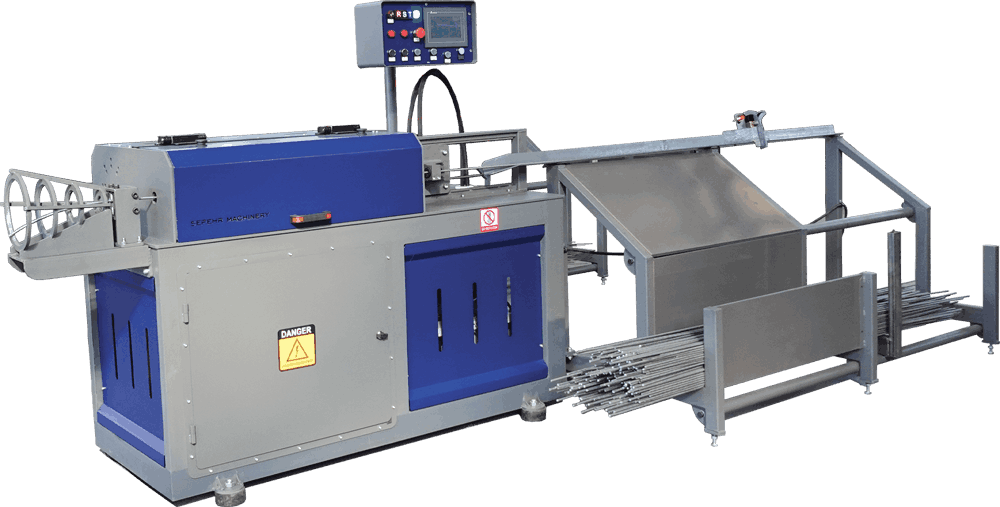
Introduction to the Components of the Wire Straightening and Cutting Machine
The Wire Straightening and Cutting Machine is designed to convert wire from coil form into straight-cut lengths according to the desired specifications.
If you are planning to order or purchase this machine, there are several important factors you should consider.
Factors Affecting the Quality of a Wire Straightening and Cutting Machine
- Wire production speed
- Low noise: Wire straightening and cutting machines typically generate considerable noise. However, proper chassis design and precise balancing of rotating components can significantly reduce noise levels. The Mesh Metal Wire Straightening and Cutting Machine is specifically engineered to minimize operating noise.
- Operator-friendly operation: The machine is designed to make operation, adjustment, and daily use as simple and convenient as possible.
- Low wear and maintenance: The use of an inverter and hydraulic system significantly reduces mechanical wear and extends the service life of the machine.
- High safety standards
- Consistent production quality: This includes straightness of the wire, accurate cutting lengths, and smooth cut ends without sharp edges.
- Minimal need for continuous operator supervision
- Easy and fast adjustment
- Ability to process wires with different diameters: The machine can be quickly adjusted to accommodate various wire diameters.
Components of the Wire Straightening and Cutting Machine
The Wire Straightening and Cutting Machine consists of three main sections:
- Wire Feeding
- Wire Straightening
- Wire Cutting
Wire Feeding
In this section, the wire is prepared for entry into the Wire Straightening and Cutting Machine. Whether the wire is supplied in coil form or in another form, it must enter the machine smoothly, continuously, without tangling, and at a uniform rate. Otherwise, the risk of wire breakage inside the machine increases significantly, resulting in inconsistent production.
For this reason, a decoiler (pay-off) is used in the wire feeding section.
Decoiler (Pay-Off)
Raw wire is typically purchased in the form of a coil. As its name suggests, the decoiler is responsible for unwinding the coil and providing a continuous and uniform wire feed.
As shown in the image, the wire coil is placed on the decoiler. The decoiler used in Mesh Metal machines is equipped with an automatic mechanical brake.
The wire coil may not always unwind at a constant speed. In some sections, the coil may unwind easily, while in others it may become tighter and slow down. Under normal conditions, these variations in unwinding speed can cause an inconsistent wire feed.
To prevent this problem, an automatic mechanical brake is installed on the decoiler. If the decoiler rotates faster than required, the brake is activated to prevent excess wire from being released into the machine inlet. This ensures that the wire enters the Wire Straightening and Cutting Machine smoothly and continuously, helping prevent tangling and wire breakage.
Note: Using a properly matched decoiler reduces labor costs because there is no need for continuous monitoring of the incoming wire. The wire is fed into the machine smoothly and consistently with minimal operator intervention.
Wire Straightening
In this section, the wire enters the machine through the inlet guide. It is then pulled forward by the wire pulling rollers and fed into the machine’s straightening head.
Inside the straightening head, twists and bends in the wire are removed. The straightened wire then exits through the second set of rollers and is guided to the next stage: wire cutting.
- Machine Inlet Guide:
To minimize friction between the wire and the machine inlet, four bearings are installed at the inlet from four different directions. These bearings guide the wire directly and smoothly into the machine.
- Wire Pulling Rollers:
The Wire Straightening and Cutting Machine typically includes two sets of pulling rollers. As the name suggests, these rollers pull the wire forward and move it through the machine.
Each pulling unit consists of a pair of upper and lower rollers. Each roller has a groove designed according to the wire diameter, allowing the wire to pass securely between the rollers.
The rollers rotate at high speed, pulling the wire toward the straightening head and cutting unit.
The roller rotation speed and the pulling force required vary depending on several factors, including wire diameter, machine speed, wire material, required cutting accuracy, and other production parameters.
Straightening Head
The straightening head of the Wire Straightening and Cutting Machine is available in two types: Rototr-type and rolling-type.
The main difference between these two designs is the level of wire straightness they can achieve. Rotor-type straightening heads generally provide higher straightening accuracy than rolling-type systems.


Rolling-Type Wire Straightening Head:
All sections of the rolling-type Wire Straightening and Cutting Machine are essentially the same as those of the hammer-type machine; the only difference is the straightening head.
The straightening head in the rolling-type machine uses two rows of horizontal and vertical rollers, typically with an odd number of rollers, to straighten the wire. The wire passes between the rollers, which remove its twists and bends and produce a straight wire.
Advantages of Rolling-Type Straightening Compared to Rotor-Type Straightening
- Lower noise level
- Higher operating speed
- Lower wear and tear
- No need for lubrication
Note:
Due to the design of the rolling-type straightening system, it may have approximately 2 cm of straightness deviation over a 1-meter length. Therefore, rolling-straightened wire is generally used for applications where a very high level of straightness is not required.
Wire Cutting
In this section, the wire interacts with three main components: the cutter, wire guide groove, and electronic sensor.
The wire is pulled by the second pulling unit and guided into the designated groove. At the end of the groove, the electronic sensor sends the cutting command, and the hydraulic system performs the cutting operation. This cycle is then repeated continuously.
The maximum speed of the Mesh Metal Wire Straightening and Cutting Machine is 75 m/min.
Cutter
Depending on the intended application of the straightened wire, the cutting unit can be designed either with a cutter featuring a cutting surface matched to the wire diameter or with a wedge-type cutter.
The first type offers several advantages, including no burr formation and higher cutting accuracy.
Wedge-type cutters are suitable for applications where high cutting accuracy is not required. This type of cutter can deform the wire during cutting, leaving the wire end sharp and pointed, which is not ideal from a safety perspective.